Several folk are starting horizontal hives (aka Kenyan or long hives) this year [2010] whereas the main hive of choice last year was the Warré
- see footnote.
There are, however, a couple of issues around the 'management' of the horizontal hive that, from my own experience, I don't think work so well so I have been seeking advice from a friend, and experienced beekeeper,
Gareth John, who uses horizontal hives and whose opinion I really respect. Thank you Gareth.
YABeeP members who have recently built horizontal hives may wish to take Gareth's suggestions on board when starting their own hives and if so, will need to make a small adaptation to their hive entrances before they are populated. At least you will have time to consider this alternative before starting and, if unsure, discuss it in the group or seek advice on internet forums like the
Natural Beekeeping Network.
Background
The horizontal hive we use follows
plans generously made available by Phil Chandler -
The Barefoot Beekeeper. Admittedly, we tend to make a couple of adaptations by adding top bar rims/buffers, extended varroa trays and windows, but the main hive body is exactly to Phil's design. I always recommend that new horizontal hive users buy his book as it's excellent value for money and gives you information on how to manage his hive design.
Phil's plans use 3 entrance holes in the
middle of the sloping side of the hive and use
two follower boards either side of the colony to expand the size of the hive as the season progresses and retract it as winter approaches.
Irrespective of hive type bees tend to keep their brood area (where they raise their young) in the general vicinity of the entrance of their hive and use the further reaches of the hive for storage.
The Problem
By using a central entrance the beekeeper has to, as the season progresses, decide whether to move the follower boards to expand the hive area on the left or right or both sides of the colony. If only expanding in one direction, probably the most logical way, you are likely to meet the end wall well before the season reaches its peak in which case you then have no alternative than to expand at the opposite end. This can cause disorganisation for the bees and will certainly give you, the beekeeper, additional complications when deciding form what part of the hive to harvest comb, how to refresh tired brood comb, etc.. If you expand both sides simultaneously then again bees can be confused and they end up expanding outwards in two directions - basically you end up with a zig-zag colony.

The argued advantage for this central entrance method is that it provides more flexibility for you and also provides a false wall at each end to give additional insulation in the winter.
The Solution
The alternative suggestion, on the other hand, is to use end entrances and just one follower board as is commonly used in horizontal hives in other parts of the world. Indeed since suggesting this I have noted that most of the long style hives I have seen from around the world and those in use in earlier history tend to have mostly end entrances.
The end entrance provides a fixed starting point with expansion in only one direction – you have the whole length of the hive to expand into. Consequently, you end up with a hive with brood at one end and honey at t'other.
Additional advantages include a single direction for the bees to work when consuming stores over winter – they don't have to travel back and forth.
You also have more space at the opposite end to the entrance where you can store your bits and bobs or possibly raise another nucleus – I often found when the hives were getting full that 2 small areas were just too small for other uses whereas one larger space would have been much more useful. This additional space also makes it easier to raise 'splits' in the same hive body. A split is a way of raising an artificial swarm – you split your colony into two having ensured that each part of the split has the correct types of bees plus a queen or viable queen cells.
It is also probably easier for you to estimate the amount of honey you have with an end entrance as you will know that one end is brood and the other extreme pure honey store. With two ends in use there will be two ends where honey may be stored and the demarcation line is not always so obvious – you double the judgement needed.
An End Entrance
We are still advised to have the 3 x 1" (25mm) entrance holes at one end of the sloping wall, rather than the flat end - about 2" from the floor. This way the overhang provides better shelter and mouse protection for the entrance. It also means that your entrance is the 'cold way' on your hive giving your bees access to the sides of the combs.
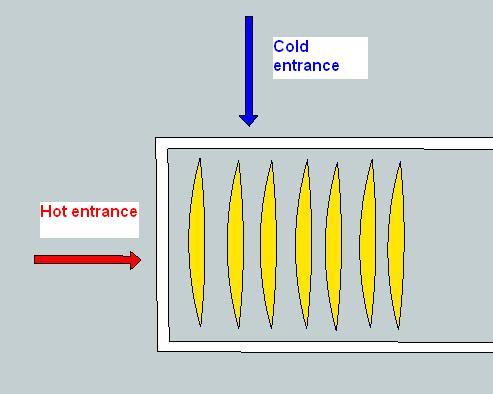
Note: Beekeepers refer to an entrance that that runs parallel to the comb as 'cold' and one that runs at 90° to the comb as being 'hot'. There are argued pros and cons for each but most UK horizontal hive beekeepers tend to use a cold entrance.
Of course, you are free to decide for yourself whether you prefer to use a cold entrance in the sloping side (see illustration) or a hot end entrance.
In Conclusion
Given my previous experience with central entrances and this new advice I am fully persuaded to try the end entrances myself – it makes total sense and will probably make my beekeeping easier. If you wish to do the same then, like me, you will need to stop your central entrances and add 3 holes to one end of the hive. As per Phi's original plans you can still have a second single entrance at the opposite end and side of the hive for future use if you ever choose to do a split or temporarily house a second colony. This second entrance will need to be plugged with a stopper until needed.
For
YABeeP members I have purchased a new, more meaty, hole cutting saw since
the last hive building workshop so please feel free to bring your hives back and make use of it. However, you'll have to buy your own champagne if you want the corks to bung up the old holes - though I could be persuaded to assist you polish off the contents of the bottle to save it going to waste!
Robin Morris
~~~~~~~~
Footnote: The Warré hive is, in my opinion, the best hive for both the bees and those starting out keeping honeybees due to its simplicity and non-interference management style. However the horizontal hive offers other advantages such as the ability to produce splits so makes an excellent follow-on hive.




 Posts
Posts


