YABeeP is attempting to use a sustainable approach to protect and increase the local bee population. Our interest is in honey, bumble and solitary bees. We use bee-friendly methods to our help bees; not exploit them.
YABeeP members will all know that the group continues, as before, meeting the second Saturday of each month, this year we meet in Claverham Village hall - details of dates, time and venue can be found here.
However, YABeP has a wider following than just our membership with regular visitors from all over the world. This post is to update our distant followers as to the recent changes and why this website is no longer being updated.
Since its start in 2009, YABeeP has been run, more or less single handedly by Robin. Having taken early retirement he was able to devote time to it. However, last autumn Robin decided he needed to step back from running the group - partly as he felt he was becoming stale - new blood was needed, and partly to spend more time with his severely disabled wife who had become unwell. The running of YABeeP was consequently handed over to our new enthusiastic Chair, Sal Pearson - see this post for more information. A group of members met over the winter to decide how the group should go forward.
This website was developed by Robin as a resource that members could use and it has been quite successful doing so - basically it was his baby. However, it takes a lot of work and a certain set of skills updating it. The major users of this site are worldwide rather than local members. Robin agreed to continue maintaining the site with the occasional update, though we decided that it would no longer be a priority for YABeeP, we would instead concentrate our activities on our local members - meetings, training, hive building, skep making, etc..
Unfortunately, in April 2013 Robin's wife, Sarah, sadly died. This has hit Robin very hard, having spent so much time over the past years devoted to her care. It was Sarah who encouraged Robin to start the group and she was his continuing source of support and encouragement. Robin has indicated that he needs some space to manage his grief and has consequently decided to take a sabbatical from YABeeP. We, of course wish him well.
Sarah Perry Morris 1959 - 2013
Consequently, we have decided to 'park' this website for the time being until either Robin chooses to return or someone with the necessary skills and motivation steps forward to take on the task. It will remain live as a continuing resource for members and our wider audience, but for the time being there will be no further posts or updates.
Sunday, 24 March 2013
This email to YABeeP members is being posted on our website as it may be of interest to others who follow this blog:
We have been contacted by our friends in the Natural Beekeeping Trust about a former student of one of their first beekeeping courses, Vanessa Clarke, who was a BT executive at the time. Vanessa went on to a Rudolf Steiner Waldorf Teacher Training course.
Now in her last months of teacher training Vanessa is proposing a project to further natural beekeeping which YABeeP would like to support.
Vanessa reports: " I am in my last months of study and for my final project, I have chosen to offer UK Steiner Waldorf schools practical ways of incorporating natural beekeeping methods into their curriculum. There has been quite a lot of interest from Steiner Waldorf teachers - if I can make the integration as painless, efficient and economical as possible.
My vision is that Steiner Waldorf schools build and manage their own hive/s with the help of a local mentor. If this is not possible, another suggestion is to have school children regularly visit local apiaries, In order to determine the feasibility of such a project, I will be sending out two surveys - one to natural beekeepers and another to Steiner Waldorf teachers."
Depending on the results from the pilot, the hope is that the project will be offered to all schools - see attached.
YABeeP is asking members plus any other Natural Beekeepers whether you would be willing to help Vanessa getting the "evidence" she needs by completing the questionnaire (LINK HERE), and forwarding it to other natural beekeepers who are likely to be interested or might co-operate. This could be significant for future bees.
If you have not been watching the excellent series on Insects that the BBC has been running over the past couple of weeks spend a while to catch up on the BBC iPlayer. 2 must see programmes for those interested in bees are:
Insect Dissection: How Insects Work - available on iPlayer(sorry, BBC iPlayer is only available in the UK)
Planet Ant: Life inside the Colony - which is being repeated on BBC HD (Freeview channel 102) today at 19:00 hours or can be viewed on your pc. Ants and bees are very closely related.
Gareth John, a long-time friend of YABeeP, delivers training courses in Natural Beekeeping from his home in West Oxfordshire - details here. For the last couple of years Gareth has kindly agreed to run some of these for us here in North Somerset.
The next course he will be running in Yatton is below. (Note: this course is a one day version of the two day course run from his home. It omits those parts of the material that relate to hive choice as between horizontal and Warré hives on the basis that YABeeP members use mainly Warré hives.) Who is it for?
Primarily designed for those new to keeping honeybees wishing to use bee-centred methods and a holistic approach in Warré hives. You must be a YABeeP member to take part in this discounted offer.
Dates Saturday 4th May 10:30 am to 4:30pm. Numbers To maximise the attention given to each attendee, numbers are limited where possible to 8 for each course. Spaces will be allocated on a first-come-first-served basis - see Booking below for how to secure your place. If there is too much demand then a second day may be arranged separately. Cost The cost will be £35 per person for the day. Teas and coffees will be provided but you will need to bring your own lunch. Course Outline
10.15Arrival, coffee, biscuits and comfort calls. 10.30 -11.30 The Honeybee Colony: An Organism Like No Other 11.30 – 12.30The Pulse of The Bee: The dynamics of a honeybee colony and its interaction with its environment 12.30 – 1.30Lunch Break 1.30 – 2.30The Natural Beekeeping Year 2.30 – 3.30 Practical Demonstration of Warré Hives 3.30 – 4.30 Trusting the Bee
Booking YABeeP members have been sent an email detailing how to book. This discounted opportunity is only available to YABeePers. This is a great opportunity for us to receive some excellent training at a very reasonable cost from someone who I believe to be one of the best trainers in natural beekeeping in the country. If you want to take advantage of this book early as the spaces are limited. Sal Pearson
Daily Telegraph
The Daily Telegraph today published an article on Natural Beekeeping which you can read on-line here. The article was written by Jean Vernon who has been a member of YABeeP since 2009 when we first started. It features Heidi Herman, the Natural Beekeeping Trust and the Sun Hive, all of which YABeeP fully supports. Some of us were lucky enough to attend the conference Heidi arranged last year and meet her and visit the Trusts's wonderful apiary.
John & Gareth enjoy Heidi's bees
(yes, that is an occupied Sun Hive)
We expect that there will be several negative comments from some dyed-in-the-wool conventional beek's so I would encourage all natural beekeepers to leave a Comment in support on the Telegraph's webpage. To do this if you don't have a Telegraph account you need to first register by clicking on the 'Register with the Telegraph' link just under the text of the article - it's free.
Bees Flying - is it a problem?
The recent unseasonal warm weather over and since Christmas has meant our bees have often been out flying. This has been a concern to many who are aware that 'conventional' wisdom suggests it is worrying if the bees have broken winter cluster. This 'worry' however, ignores the fact that bees have been doing this for millions of years; it's not unnatural for some winters to have warm spells.
I have been advising our members not to worry and leave your colonies well alone; resist the 'conventional' pressure to feed - rest assured that the bees know what they are doing. Even a peep through the window could add stress to the bees at this time of year.
A Sun Hive with a
supered honey box
Whilst this is easy for me to say I recognise it can be hard to do, especially for those under pressure from others who are shovelling sugar in their hives by the Kilo. For a little reassurance see this post by Heidi on the Natural Beekeeping Trust's website. I love her approach that we "can only hope and trust that the bees, unlike us, know what they are doing ".
After all, are we such experts in bee behaviour? I'm certainly not. We must abandon our human instinct to worry and think that we should be interfering; our 'we know best' attitude. I agree with Heidi, we must learn to trust our bees!
I also belong to Jonathan Powell's Frome & Bruton area natural beekeeping forum and saw this excellent post there last night. It was so good I imediately asked Jonathan & Emma's permission to share it here whuch they kindly granted. Emma is also a member of YABeeP. Enjoy Robin Morris YABeeP Web Editor: _________________________
Bees and Tolstoy
Just reading 'Honey and Dust' by Piers Moore-Ede and was struck by this quote from Tolstoy (an avid beekeeper):
Tolstoy by Repin 1901
(picture Wikipedia)
"A bee settling on a flower has stung a child. And the child is afraid of bees and declares that bees exist to sting people. A poet admires the bee sucking from the chalice of a flower, and says it exists to suck the fragrance of flowers. A bee-keeper, seeing the bee collect pollen from flowers and carry it to the hive, says that it exists to gather honey. Another bee-keeper who has studied the life of the hive more closely, says that the bee gathers pollen-dust to feed the young bees and rear a queen, and that it exists to perpetuate its race. A botanist notices that the bee flying with the pollen of a male flower to a pistil fertilizes the latter, and sees in this the purpose of the bees existence. Another, observing the migration of plants, notices that the bee helps in this work, and may say that in this lies the purpose of the bee. But the ultimate purpose of the bee is not exhausted by the first, the second, or any of the processes the human mind can discern. The higher the human intellect rises in the discovery of these purposes, the more obvious it becomes that the ultimate purpose is beyond our comprehension. All that is accessible to man is the relation of the life of the bee to other manifestations of life."
Tolstoy in War and Peace (First Epilogue ch. 1)
Wishing everyone a very Happy New Year.
Emma
_________________
Jonathan's response:
Emma
That is a great quote. While writing the course I have been thinking very hard about what is natural beekeeping? It seems very clear to me that it is when we are supportive of the bee bien#1 (here I use the
German word which covers the undividable bee organism which includes the three castes, comb, shelter, micro bacteria local flower environment etc). So natural beekeeping requires us to understand what that is first before we can be supportive.
Your quote reminds me that humans can see something and have so many different views of the same thing, and true insight on what the bien is probably requires years of not only study (because we are not
bees!) but also reflection on what our motives are and how that might colour our views.
So, if we say that bees are not greedy (they share their food equally and all die together when they run out, they feed the drones and heater bees, they fly to exhaustion in summer) then if we take honey we should remember that the bien is not greedy.
If we say the bien is without delusion (they will eat their own brood when there is no food, they supercede the queen when she starts to fail, they kick out drones when they are of no further use, they dump sick bees away from the hive) then perhaps we should not try reverse situations which are beyond hope and not be afraid of the bold decisions for the good of the bien.
Do we support the bee environment with our shopping choices? Do we use weed killers?
Is what I am doing best done by the bien - after all they have been doing this stuff for 20 million years ?
The bien has no hierarchy - so is bee KEEPER the correct approach?
There are so many aspects we could consider and apply that to what we do.
I think we can slip in and out of being a natural beekeeper depending on our understanding of the bien. When I take a flight, I'm not being a natural beekeeper as I'm not supportive of the environment - it's a
choice I have made. I personally think that following the bee bien is very good for humans - it gives us great insight. For others they may think that its just an insect that gives us honey. Going back to your quote - it depends on your view point.
Jonathan
____________________________
Editor's comment:
Contact details of the Frome & Bruton natural beekeeping group can be found under "Other local natural beekeeping groups:" in the right hand column.
Dare I suggest that the second beekeeper in Tolstoy's quote describes a natural beekeeper?
#1Bien is a German word (pronounced bean) meaning the whole being of the colony - see this page from Gaia Bees for a fuller explanation.
In October Robin announced that, due to a change in his personal circumstances, he was having to relinquish some, or possibly all, of his responsibilities in running YABeeP. Having organised the group more or less single handedly since its creation in 2009 it was time for a change; was there to be a future for this group or was it time to call it a day?
In the event several members equally passionate about natural beekeeping came forward and talks have been going behind the scenes to take things forward. A steering group has been established and following a couple of meetings Sal, the new Chair, today announced to the membership the shape of things to come. Her message follows:
Message from the new Chair:
Hailing all Natural Beekeepers of YABeeP
Yohoho. Firstly, a reminder of the Christmas gathering at Robin & Sarah’s on Saturday, Dec 8th at 10.30a.m. onwards. See you there, tinsel, tasty bits an’all.
Also some reassurance that YABeeP will continue with few changes, apart from the “Chair” & venue for the meetings.
As the new Chair, I would like to introduce myself to you all: Sal Pearson from Claverham. I am new to beekeeping/hosting but rest assured that Robin remains in the group & we also have James who has oodles of years’ experience of beekeeping.
I may be fresh to this beekeeping malarkey but have rapidly become totally immersed with the bees in my garden (in truth, probably a bit of a bee-bore, but hey, can’t bee helped!!) & as a consequence have become aware of much wider & more pressing issues surrounding this delightful occupation: environment change, weather, pesticides & politics to name but a few. Perhaps they are issues for the group….time will tell. If you want to know about neonicotinoids however (& how to spell it!!) I’m your gal.
The venue: in 2013 the group will meet in Claverham village hall (map) in the conservatory, every second Saturday of the month, beginning February 9th 10.30a.m. The conservatory is next to the bar, which won’t be open till later (sorry folks) but will hopefully be warm & comfortable. Tea, coffee & biscuits will be available. There will be a meeting door fee of £2.00 per person (excepting children) to cover costs such as room hire & refreshments. This means we can drop the annual £5.00 donation request.
YABeeP will be supported by a steering group of Viv, Mark & Sue, James, Robin & myself all doing a variety of tasks to keep us all going…..thanks to all. If you have any enquiries about any of this contact me and I will try to answer as best I can.
Coming up: there will be a couple of days hive-building. Places are limited to 6 per session due to space, so let me know if you are interested as it will be a case of 1st come, 1st served.
There will also be a day of skep-building to be confirmed.
I look forward to seeing you all on Feb 9th 2013 at 10.30 a.m in Claverham village hall. The full list of dates for 2013 have been agreed & are published on our website (link) ….get them in your diary!
YABeeP aims to
provide peer support to individuals and families who want to
encourage both wild and honey bees and maybe keep bees themselves. We
advocate using bee-friendly natural bee-keeping methods.
Where our members keep honeybees they do so primarily for the benefit
of the bees themselves, not in order to exploit them for forced honey
production or personal profit1.
2013 Meeting dates:
February
9th
- Meeting - this month's topic "Types of Bees" - Ali Twigg
March
9th- Meeting
- this month's topic "Understanding 'Natural Beekeeping'" - Robin Morris
April
13th- Meeting
- this month's topic "Getting Your Bees" - Robin Morris
May
11th- Meeting - this month's topic "Planting for Bees & pollinators" - Simon Johnson. Simon is back by popular demand. Having trained and studied as a Parasitologist Simon's enthusiasm and love of his subject genuinely had us enthralled at his 2011 talk, especially his horror tales about Alien and vampire insects.
June
8th- Meeting
July
13th- Meeting
August
10th- Meeting
September
14th- Meeting
October
12th– Meeting
November
9th– Meeting
December
14th- Meeting
Place & time
For 2013 our programme starts in February running through the year. We will
continue to hold our meetings on the
second Saturday of each month starting at 10:30am. This year we will
meet in The Conservatory,Claverham Village Hall –
click
here for map. Meetings last around 2 hours and, weather permitting,
includes a chance to see bees in action.
Why do we meet?
Meetings allow us to:
welcome new
members to learn about our aims and principles and decide whether
they wish to join us;
provide an
environment to network with each other to expand our knowledge, ask
questions and share new ideas and thoughts on helping bees;
provide an
opportunity to get hands on with bees (dependant on weather of
course) and see a working hive/bee box;
meet socially and
enjoy the occasional BBQ, picnic, etc., after all life’s not all
about bees.
Meeting format
YABeeP believes in
holding informal meetings; we don't instruct our members or provide
formal training courses but use a 'learning through doing with
support' philosophy. Meetings are used to provide peer support and
help for those new to bees as well as share experiences and learning
amongst those who already keep them. We also often have short themed
talks at our meetings, mostly given by our own members (volunteers
always needed!) but occasionally bringing in a local(ish) expert.
Weather permitting, we provide an opportunity to let members get up
close and personal with bees and experience the workings of the
various bee homes we use following the formal meetings.
Workshops
In addition to our
monthly meetings we also arrange practical hive building workshops. These tend to all day affairs which allow
members to build their own hives for honey bees or homes for bumbles
and solitary bees. As well as being highly productive – you should
expect to complete your project within the day - the workshops held
to date have all been great social events!
we are also
running two skep building days for members.
These workshops are only open to YABeeP members who are notified of the dates privately. They will not be published on this website in advance.
If you wish to join one of our meetings we'd love to see you, just come along!
Sal Pearson
Chair, YABeeP Steering Group
~~~~~~~~
1For a
fuller explanation of what we mean by bee-freindly 'natural
beekeeping' see
this page.
You never know where you are going to end up when taking swarm calls. Also, you have no idea how difficult it will be to gather the bees. Well, today's call proved to be both the most spectacular in terms of location and also one of the most challenging deciding how best to recover the bees.
The swarm in question had chosen to settled on the stern of Isambard Kingdom Brunel's historic ship, the S.S. Great Britain. Well, you can't turn down a call like that, can you, so it was off to Bristol to see what awaited.
What a place to gather; right above the unicorn's horn (click any picture to enlarge)
On arrival I met with the manager, Gary Musson, who explained "You can't miss them, they are above the first unicorn"; was I in some sort of a fairy tale? Sure enough, the bees had swarmed in earlier that afternoon and settled on the stern of the ship. Originally the majority were on board the edge of the deck, but by the time I had arrived they had moved aft, out of the wind, to spill over the rear gunwale and park just below the stern railings. This presented a problem in that they were very difficult to reach.
The drop to the water below! (click any picture to enlarge)
A challenge To catch them from below was difficult as they were about 15 feet above the glass bottom moat that surrounds the ship. My swarm pole would just reach them but collecting them this way would mean that any fanning bees were a long way from those that remained on the stern plus there was a real danger of drowning any bees that fell outside the swarm pole bucket.
A row of heads looking up as if to say
"catch us if you can!"
To gather them from the deck was compromised by the stern railings and netting which prevented me from reaching to hold a box below them - again any dropped bees would certainly drown. Unfortunately I didn't have my climbing harness with me, although I suspect that my hanging off the rear of the ship bee box in hand might have caused issues with their their Health & Safety policy! There consequently followed three quarters of an hour problem-solving how best to gather the bees.
In the end a Heath Robinson catching box was made from a cardboard box, some sticky tape and wooden slats - a Blue Peter badge should be awarded for its construction! It is right when they say that the planning is the hard part for, once made, the resulting catch was easy and straight forward.
Within a few moments the bees were scooped off the hull and poured into a Warré box - job done! - see the video below to see how quick it was once planned.
(Use the YouTube 'full screen button - bottom RH corner)
Construction fun with sticky tape!
As if to oblige and to give their seal of approval the bees were soon to be seen fanning in their new home's entrance calling the strays to join them. All that remained then was to cordon off the immediate area around the hive box as there was a private function just starting and leave the hive for collection around dusk when all the strays and returning scout bees had returned. A housed swarm fan a pheromone into the air to tell the flying bees where they are so they can join them. This will also attract returning scout bees who will have been out house-hunting for this new colony not knowing that a home had already been provided.
Gary & Arwyn watch the newly housed swarm settle.
Our Heath Robinson invention is to the left.
The hive will be collected tonight by Gareth & Dianne, the YABeeP members who will now care for and cherish this new colony.
My special thanks go to Gary and Arwyn who so bravely helped with the catch despite my having only one bee suit between the three of us. I even sensed some disappointment from them when we came up with the Heath Robinson box answer, as under an earlier plan they were looking forward to hanging off the railings helping hold the box while I scooped in the bees - sorry guys!
My thanks also to Ian Thomas of Chew Valley Pest Control who referred SS Great Britain's distress call to me. Bees are not pests and most reputable companies refer bee calls on to local beekeepers to collect.
It's been about 15 years since I last visited IKB's historic ship. She has a special place in my heart as she returned to Bristol when I first moved here. I can only thank the bees for bringing me back to see what a great job they have made of her restoration, I'll certainly be back for a full investigation. Visitor centre details here.
Robin Morris
19 July 2012
More photos......
Swarm catcher extrordinaire!
Though I don't know why he's smiling as at this point he had no idea how he was going to recover the bees
Following a peculiar start to the spring with regards to the weather, unusually hot followed by prolonged cold and wet, the recent hot weather has allowed the bees to get their act together. The swarming season has consequently started.
What is a swarm?
To the uninitiated a swarm of honeybees in flight can look and sound terrifying, but in fact they are not. They are just an excited group of between ten and thirty thousand insects just looking for a new home; this is how honeybee colonies reproduce.
What a long way up!
They usually swarm in 2 stages. First they issue from their home colony and set up camp on a tree, shrub or other structure where, once they have settled, they just look like a ball of brown and often go unnoticed. This solid clump of bees then sends out scout bees looking for a new home - this can take from just a few hours to several days. Once identified, the swarm then ups sticks and moves on to their chosen home.
Some stories
To illustrate this here are a couple of our 2012 swarm stories:
1. St Mary's Church bees
St. Mary's bees calling their
sisters to their new home
(they fan a homing pheromone)
At around 8:00pm on Friday 18th May I was alerted to a swarm on the local church which they were worried may swarm during a wedding the following day. Being near to YABeeP HQ it was easy, with help from the church youth group, to get a set of ladders on site.
Using these, plus my long reach swarm catching pole I was easily able to box the bees. By 9:30 95% of the bees were in a Warré box and safely removed and are going to YABeeP members Cathy & Paul for safe keeping. NB: We would usually capture all bees but the high wind an height of original swarm meant about 200 bees were left behind on this occasion.
Robin ~~~~~~ 2. Andrew P and Sacha's bees
Now just one snip here...
While attending the course run by Gareth John this weekend we heard about a local swarm in Worle that needed a home. Later in the afternoon we went over with Robin and Sarah armed with a box from our Warré hive and Robin’s expertise!
The bees were in a small rosebush in a front garden; the owners of the house had tried ringing several people from the Yellow Pages before contacting YABeeP and so were glad to see us. Robin carefully trimmed the branches of the bush to get access to the main stem supporting the swarm. He then cut this and shook the swarm into the top box of the Warré hive before carefully turning it over onto the specially adapted floor. This left a small gap for the remaining bees to enter the box.
Fanning to call the sisters
- click & zoom to see their
bums in the air -
At this point many bees were flying yet not at all aggressive and we were able to stand amongst them and watch those on the box waft pheromones to attract the remainder in. An amazing experience to have been part of, having never even seen a swarm before! We left the bees to settle for a couple of hours and also to allow scout bees to return.
The proud parents
We returned at dusk to collect them and found all but three bees were inside. We shut up the box safely and Andy had the precious cargo on his lap home to Yatton. By the time we got back it was nearly dark, so having let them settle for 15 minutes we carefully assembled the hive to include our newly full top box. We found a few bees on the floor which we shook onto a ramp by the hive entrance.
Their new home
The following morning they were already flying and closely inspecting the hive and their surroundings. We hung up a sheet to protect them from direct sunlight for a few days (the hive gets some direct sun between 10am and 12 noon). We have noticed that the bees have aggregated into a small ball inside the hive and are making lots of flights, returning with pollen on their legs. Many thanks to Robin and Sarah for coming with us.
Sacha
They go in quickly - Just after
boxing / 20 mins after / 30 mins after
Video of Andrew & Sacha's bee install
(to watch full screen click the YouTube icon in bottom RH corner)
"Gently put your finger into the swarm, like this, can you feel how warm it is?" said Robin......
It was a virgin swarm apparently, with a young queen hatched this year, found conveniently at head height in a small conifer in a front garden in Nailsea. Robin shook them into the box first time and then we stood watching, surrounded by bees as they gradually homed in on the box, guided by a pheromone they release to broadcast their location.
By the time I returned at dusk they were all safely inside the box and after the short car journey home they were installed in their new hive without incident.
I spent the next couple of days transfixed as they busied themselves with reconnaissance flights round and round the hive, and then eventually some began returning laden with pollen. By day 3 a small section of pale comb was just visible and there was something very comforting about seeing the privet hedge at the end of our street, in full flower and covered with what must have been my bees. Fingers crossed for some warmer weather so queenie can fly out and do her stuff with the boys.
Jeremy's bees new home
Jeremy
Video of Jeremy's bees being boxed in Quarry Road, Nailsea
~~~~~~
5. Sarah M's bees - this shows that baiting hives does work!
I have to show you a swarm arriving at my Horizontal Top Bar Hive this afternoon! My original colony had dwindled to near extinction and then some bees arrived. Robbers? Scouts? They bumped off the remaining bees and seemed to be hanging around and guarding, though there were only a few.Then this afternoon, I was talking to neighbour when the sky went dark with bees heading for my hive. It took about 3 hours for them all to squeeze in (I had not got round to enlarging the opening from a quarter cork). So, voila! It seems I have two colonies now, a small cast swarm of placid stripeys in my Warré and what seems to be a big swarm of small, dark bees in my horizontal.
Sarah's swarm moves in - the most 'natural' way to get bees
Best wishes,
Sarah
~~~~~~
6. Fiona's Warré bees
I just had to add this video from Fiona showing the swarm we collected for her. Bearing in mind it was a colder damp day not a bad job. Excellent video Fiona, just a shame the chap in the clip wouldn't shut up!
[Click the Full Screen icon bottom right of video screen]
The swarming season has certainly started now. A few members have reported that their hives have swarmed or that they have managed to get a swarm.
Fortunately, Sue H' emailed me a short story and some pictures of her experience yesterday. Well done Sue, especially as it was your first swarm catch. Great news that you caught them and that, as a result, Wendy is now in business with some natural bees. We look forward to updates and more pictures please Sue and Wendy.
A reminder to others:
Remember that a digital camera is one of your best bee tools. Taking photos of your exploits not only gives you an enjoyable permanent record, it also allows you to blow up the pictures after the event and study your bees for signs of health, etc..
Sue's story
I had been watching them over the last fortnight showing signs of swarming. When I had looked at the hive around 10:00 in the morning there were very few flying so I didn't expect them to be leaving today, as the weather was not that bright.
I didn't see the swarm leave my hive, but noticed them buzzing around the back wall of the garden around 2:15 in the afternoon.
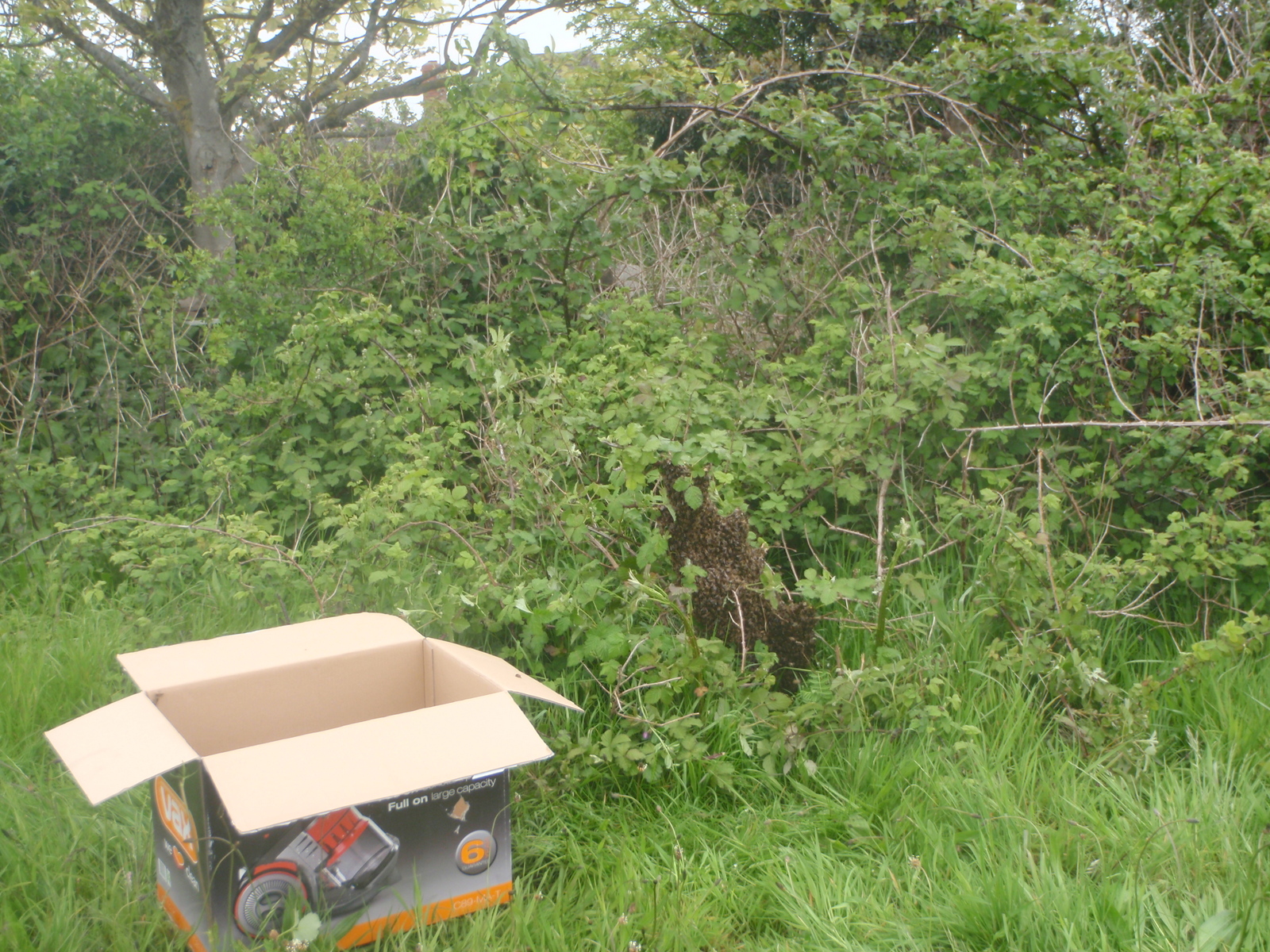
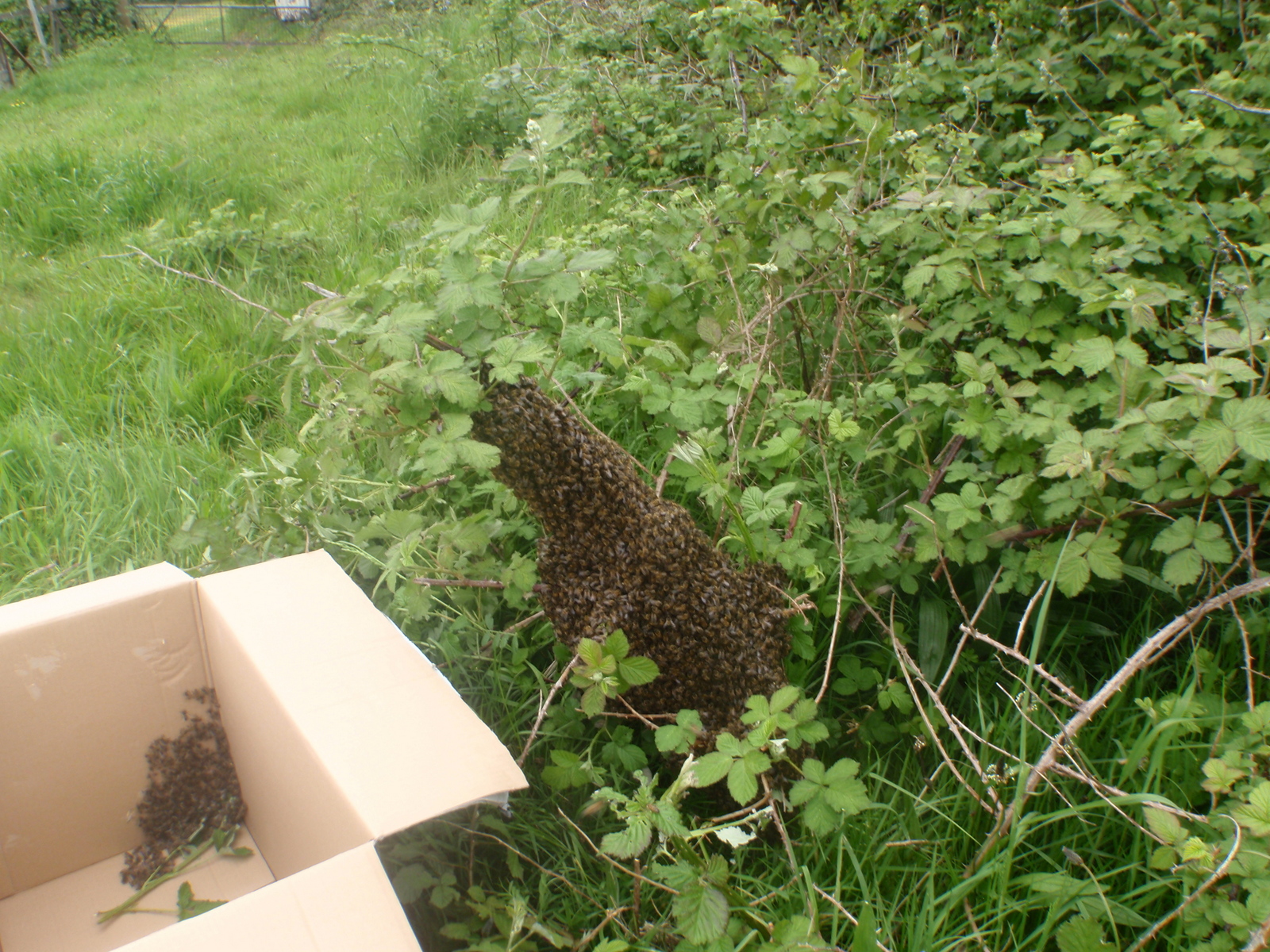
They spent about 15-20 minutes flying around the back wall before all went quiet again. I didn't see them fly off so I went into the field below my garden and found them in two separate clusters about 2-3 feet above the ground on a bramble bush. I was surprised by this as advice was to put bait hives 15 feet from the ground.
By the time I had got together my kit, a cardboard box, Wendy for moral support and returned to the field they had move into one mass closer to the ground and in more accessible position. We cut the brambles away around the swarm then cut and picked up the main stem to shake into the box. We didn't get many the first time around as some clung to the surrounding bushes, but bit by bit we added more bees to the box. By this time there were a few on the outside of the box. The box had a hole in the side as I had it on the roof for a bait hive, but the bees decided they wanted to go the edge of the opening on the top of the box.
We left the box in the field until dusk and could see no more bees going in. Then we passed them back over the hedge and tipped them into Wendy's hive.
Bill who has played host to the bees
*** click any photo to enlarge ***
Last Thursday I took a swarm call from a member of the public who had a feral colony in their garden in a tree which had blown over in the gales the week before. Removing an established colony is nearly always a 'no no', but having established that they were probably honeybees I thought I'd have a 'look see' just in case.
Comb visible at the base
of the severed trunk
Sure enough, it was a healthy colony. It had probably been there for at least 2 years and it seemed that it just might be possible to cut the trunk and move it to a member's garden for safe keeping and to carry on living as a healthy colony. Wouldn't swarms from that be worth having?!!! The tree was blocking the lawn and needed to be removed - though I am glad to report that owner agreed that rather than kill the bees he was happy that we prop up the trunk and leave the colony in situ, had it proved too difficult to shift.
As luck would have it the next YABeeP meeting was in two days time so I agreed with the householders that I'd see if we could arrange a posse of beekeepers and return that Sunday. Recruiting volunteers was easy as several came forward realising that it was an experience not to be missed.
Video of bees happily flying
Let's do it
Some of the gang assemble
Having agreed a convenient time for all involved, a motley crew of YABeePers assembled on site yesterday in glorious sunshine looking like we meant business! The bees were happily active, having clearly recovered from their trauma of a week or so ago when the tree fell. Little did they know what was about to befall them as their Sunday afternoon peace was shattered by a chain-saw wielding group of beekeepers.
The situation was assessed, a strategy was agreed, bee suits were donned and 2 chain saws were started - that tranquil garden setting suddenly became a flurry of activity, noise and purpose.
The offending laburnum tree had probably stood up to fifteen feet high. The c.15" diameter trunk rose about 5 feet from the ground where it split into 3 large branches with the rest of the tree branching off above that. The centre of these 3 main branches provided the entrance for the bees who were living in the main trunk below. The tree had suffered canker for the last few years and clearly had severe rot in a few places including the trunk which the bees were occupying. We had no clue as to the extent of the rot other than it was large enough to support a colony of bees over the years and that comb could be seen at the base where the tree had been severed at ground level by the gale. No bees were flying from the base. Had it been solid wood we could not have contemplated lifting it, but our hope was that it was hollow enough to have removed a substantial portion of the weight.
Operations started by removing the 3 main branches. We chose not to block off the bee entrance as so many were flying in the afternoon sun that it would have created as many problems as it solved. Amazingly the noise and vibration from the saws caused little concern to the bees and most of us quickly removed veils as working in bee suits ain't 'alf 'ot!
The first branch goes
Let's get digging!
We had hoped that once the top was removed we could drag the trunk onto the lawn and strap it ready for lifting, but there turned out to be a large root holding it which was unfortunately right under the fallen tree! There was no alternative but to remove the bottom section so there followed about an hour of mining under the tree to provide clear access for Fiona to swing her chain saw. Eventually, after much hard work and a sterlingly nifty bit of chain-work by Fiona it was free, though we had unfortunately had to cut off the bottom 4" of comb in order to clearing the root. Fiona was eventually able to save this once the main trunk was strapped and lifted out of the way.
All that remained now was to clear up and return at dusk, once all the bees had returned, to move it to Yatton.
Strapped and ready to shit
Amazingly, during our two and a half hours of sawing, chopping, digging and hauling the bees had remained gentle and calm throughout, not one sting was taken, despite most of us being unveiled throughout the majority of the operations. Two onlookers got bees in their hair but both were freed without incident.These are a gentle temperament dark bee - what beauties!
The Removal
At 9pm a party reassembled on site to get the trunk into the 'custard cab' for the journey home as we felt being inside the car between the axels would provide the bees with a gentler journey than bouncing around on a trailer. Moving the trunk was made more easy following Ali's epiphany to strap it to a sack barrow and wheelbarrow it along - beauty and brains, eh - dangerous!
By 10:30 pm they were settled in Yatton, on Ali's rockery awaiting their inaugural Yatton flight once day broke. As Ali lives just around the corner from where we meet for YABeeP, she has agreed to show any interested members the bees.
Safely back in their new home the following day
Afterthought
As Fiona so beautifully commented after we had done all the work, this exercise had not only provided us all with much valuable insight and experience into feral bees but it had also shown how a bunch of bee-friendly amateurs could so willingly come together to give their time and effort to save bees - she suggested this truly embodied the spirit of YABeeP - well said Fiona!
Mention must go to the YABeePers Ali, Fiona, Mark, Andrew, Ray, Sarah and your's truly who turned out work so hard on this project.
Thanks also to Martin, Mark's and my boys who provided assisting muscle for getting the trunk into and out of the 'custard cab' for the journey.
Finally our thanks go to the householders, especially Richard the assisting chain-sawer and Bill who had loved and nurtured the bees.
Robin Morris
14 May 2012
More pictures & videos (click to enlarge photos) :-
Bees fanning during the disturbances
The second branch bites the dust
Time for the big one - yet the bees fly undisturbed!
Removing a branch exposes a new entrance
Top done; now let's sort the bottom!
Fiona gets stuck in
Preparing for the first lift
The root meant we had to loose the bottom 4" of comb
It's well known that you can 'drum' bees to make them climb out of a bee box. Here the same effect is seen when Fiona vibrates the trunk with her chain-saw while she cuts off the bottom to save the bottom 4" of comb. The vibration makes the bees climb to the top of what they are on - a useful trick to get them out of a harvested honey box. Drumming with your fingers has the same effect but will probably take a good 10 minutes - kinder when honey harvesting than using a chain saw!
A queen cell is found in the bottom comb
The bottom cut is propped up to allow the bees to go home
Job done, bees removed.....
....except for a few stragglers that need scooping and placing by the entrance
I'm not missing this...
...Nor am I, though I was in such a rush I put my veil on backwards!
Unless otherwise stated, I own the copyright to all the original material on this blog. You may freely add links to this website or use the advice given on these pages to help you in your own natural beekeeping journey. However, you may not reproduce the words or pictures in any other form without my express written permission. For permissions please email me at YABeeP[at]gmail[dot]com.




 Posts


